
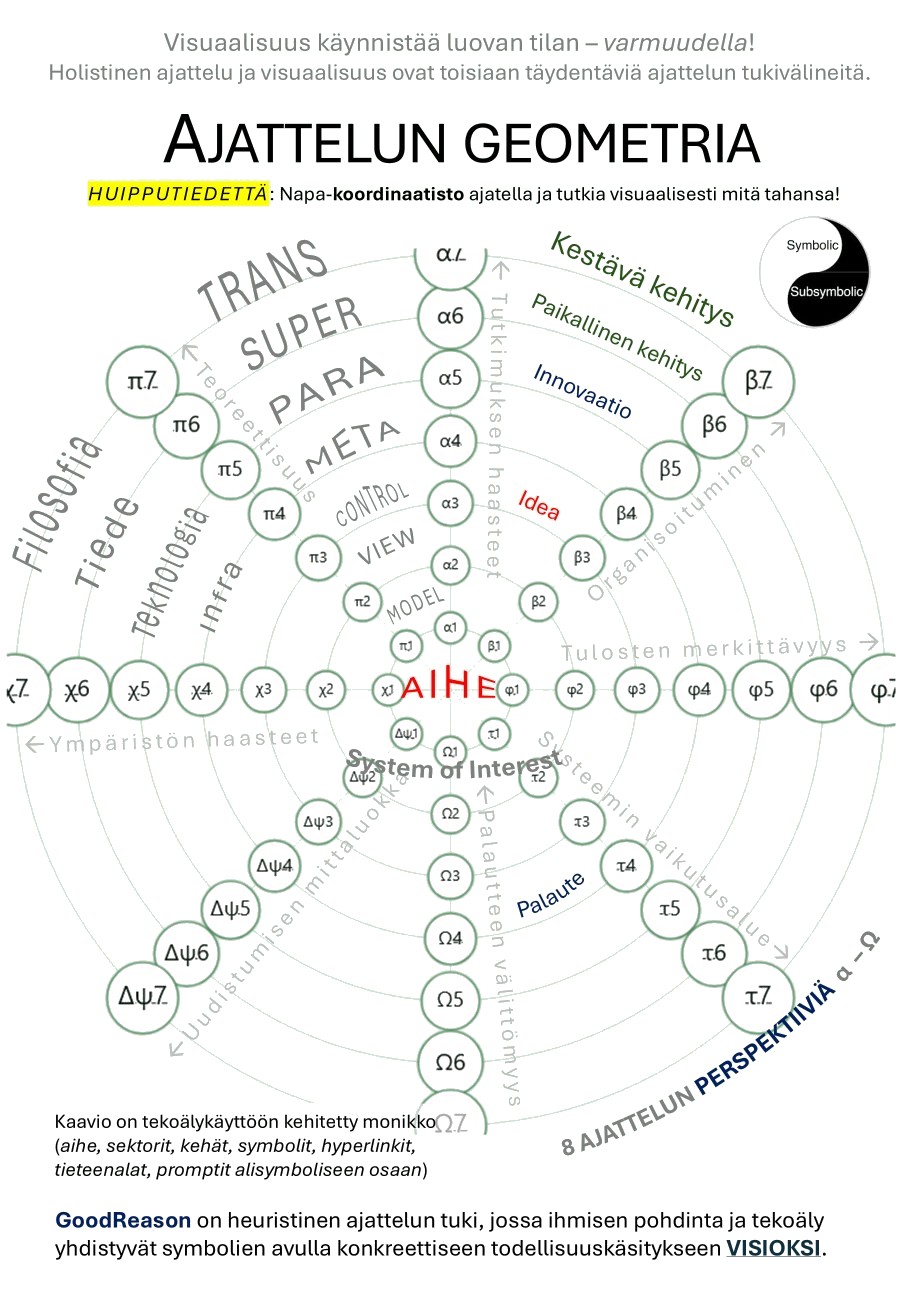
Alla Powerpoint Copilotin laatima käsitys GoodReason – metodiikasta.
Core Idea: What is GoodReason?
GoodReason is a heuristic and cognitive framework for evaluating the reliability and logic of systems, especially in the context of information security and artificial intelligence. It builds on symbolic AI (GOFAI) but extends beyond computational models, offering tools for both human and machine reasoning. The framework emphasizes the importance of admitting uncertainty (”I don’t know”) in AI systems and divides complex topics into manageable sub-models, each controlled by humans.
Structure of GoodReason
- Seven Rings & Eight Sectors: The framework uses seven concentric rings to represent levels of consciousness (from everyday to philosophical) and eight sectors to anchor expressions and symbols. These create a networked conceptual space for modeling dependencies and relationships.
- Symbolic Notation: GoodReason employs a visual language—symbols like α, β, χ, π, φ, τ, Ω, ΔΨ—each representing a fundamental aspect of scientific and cognitive functions (e.g., motivation, structure, context, analysis, theory, solution, action, feedback).
- Applications: The model is used for system design, policy modeling, technical infrastructure, societal needs, and continuous feedback. It is suitable for internet platforms and can be integrated with language models via JSON schemas.
Key Components and Perspectives
- Ajattelun geometria (Geometry of Thought): Visual and holistic thinking are central, enabling creative and comprehensive analysis. The framework supports visual tools for mapping and investigating any topic, from philosophy to technology.
- System of Interest: Focuses on sustainable development, innovation, and local/global challenges.
- Eight Perspectives (α–Ω): Each perspective covers a core function:
- α: Motivation and research questions
- χ: Ideation and system context
- β: Organization and viability
- τ: Societal reliability and human factors
- φ: Technology and solutions
- π: Theory and reflection
- ΔΨ: Analysis and synthesis for improvement
- Ω: Feedback and evaluation
Information Security Example
The presentation uses ”Tietoturva” (information security) as a multi-layered model, showing how GoodReason can structure protocols, reliability languages, policy models, technical frameworks, societal tools, and feedback mechanisms. It highlights the need for holistic approaches to cybersecurity, integrating technical, organizational, and societal dimensions.
Global Information Security Agenda
- Advocates for systemic change, shifting control from IT giants to democratic processes.
- Emphasizes the need for error-free systems, global reliability, and sustainable development in IT.
- Encourages emancipatory systems thinking and the use of GoodReason as a validation and decision-making tool.
Author and Further Resources
Eki Laitila, with 40 years of experience in symbolic AI and systemic paradigms, developed GoodReason as a tool for consulting, decision-making, and scientific inquiry. The notation and models are publicly available on GitHub and suitable for integration with modern AI systems.
In summary:
GoodReason is a comprehensive, symbolic framework for modeling, analyzing, and improving complex systems—especially in information security and AI—by combining human cognition, visual tools, and structured reasoning. It provides a universal map for scientific and practical functions, aiming for reliability, transparency, and holistic understanding.
Katso lisää: Luottamuksen perusta: https://goodreason.fi/1-luottamuksen-perusta/