
Metascience is seen as a future-oriented discipline to promote interdisciplinarity and the integration of knowledge, where GoodReason is positioned as its methodological contribution.
Toward Systemic Science of Science
1. The Need for MetaScience
Science has been the most powerful method humanity has developed for understanding the world. Yet science itself is a complex system that evolves, adapts, and occasionally fails. Fragmentation of knowledge, disciplinary silos, reproducibility crises, and the overwhelming growth of information challenge the effectiveness of traditional scientific practice.
MetaScience emerges as the systematic study of science itself. It seeks to understand how knowledge is produced, structured, communicated, and integrated. By applying scientific thinking to the processes of science, MetaScience aims to improve the reliability, coherence, and societal impact of research.
2. Beyond “Research on Research”
Contemporary metascience often focuses on evaluating research practices—statistical validity, reproducibility, and publication structures. While important, this perspective is only the first step.
A broader vision sees MetaScience as:
- the study of the architecture of knowledge,
- the analysis of scientific paradigms and their evolution,
- the mapping of relationships between disciplines,
- and the development of methods for integrating knowledge across domains.
In this sense, MetaScience becomes a systemic perspective on science itself.
3. Systems Science as the Core of MetaScience
Scientific knowledge is not a collection of isolated facts. It forms an interconnected system of theories, models, methods, and practices.
Systems science provides the conceptual foundation for MetaScience because it focuses on:
- relationships rather than isolated elements,
- interactions rather than reductionist components,
- and emergent structures rather than simple mechanisms.
From this perspective, MetaScience can be understood as the systems science of science itself.
4. The Role of Cognitive and Visual Models
To understand complex knowledge structures, science requires new tools for representation. Graphs, conceptual models, and knowledge maps help reveal patterns that remain invisible in traditional text-based scholarship.
Visual and symbolic modeling enables researchers to:
- explore interdisciplinary relationships,
- navigate large bodies of knowledge,
- and communicate complex systemic ideas effectively.
These tools are becoming increasingly important in an era of rapidly expanding information.
5. AI and the New Era of MetaScience
The emergence of advanced artificial intelligence introduces a new dimension to MetaScience. AI systems can analyze vast bodies of literature, detect conceptual relationships, and assist in modeling scientific knowledge.
AI therefore acts as a catalyst for MetaScience by enabling:
- large-scale analysis of knowledge structures,
- automated mapping of scientific domains,
- and interactive exploration of complex conceptual systems.
Human insight and artificial intelligence together can create a new form of collaborative scientific reasoning.
6. GoodReason as a MetaScientific Methodology
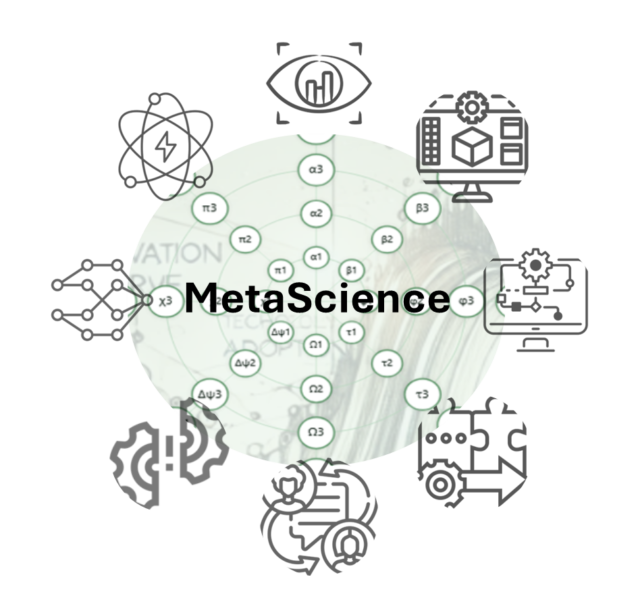
GoodReason is proposed as a symbolic and systemic methodology for MetaScience. It introduces a cognitive coordinate system that allows scientific knowledge structures to be analyzed, compared, and integrated.
The framework organizes knowledge through multiple complementary perspectives—such as purpose, theory, environment, transformation, organization, design, integration, and feedback. These perspectives form a structured way to explore complex systems and interdisciplinary knowledge.
Within MetaScience, GoodReason functions as a tool for:
- interpreting scientific knowledge maps,
- analyzing conceptual structures across disciplines,
- and supporting the integration of fragmented knowledge domains.
7. Toward an Integrated Scientific Worldview
The long-term goal of MetaScience is not merely to study science but to strengthen it. By improving our understanding of how knowledge systems function, MetaScience can support more coherent, transparent, and effective scientific practice.
In a world facing global challenges—climate change, technological transformation, and societal complexity—science must become more integrative and reflective.
MetaScience provides the framework for this evolution.
In summary
MetaScience studies science as a complex evolving system.
Systems science provides its conceptual foundation.
Artificial intelligence expands its analytical power.
GoodReason contributes a symbolic methodology for integrating knowledge.
Together, these developments point toward a new stage in the evolution of scientific understanding.