The golden age of mathematics began with the breaking of the dominance of the church
Modern science was born from the study of astronomy, when Copernicus and his followers were able to show that the epicycles created by the ancient celestial mechanics were wrong. Mathematics played an excellent role in this. For 500 years, mathematics has dominated scientific discussion, but has led to a reductionist worldview that is full of its typical problems, because mathematics lacks control over the whole.
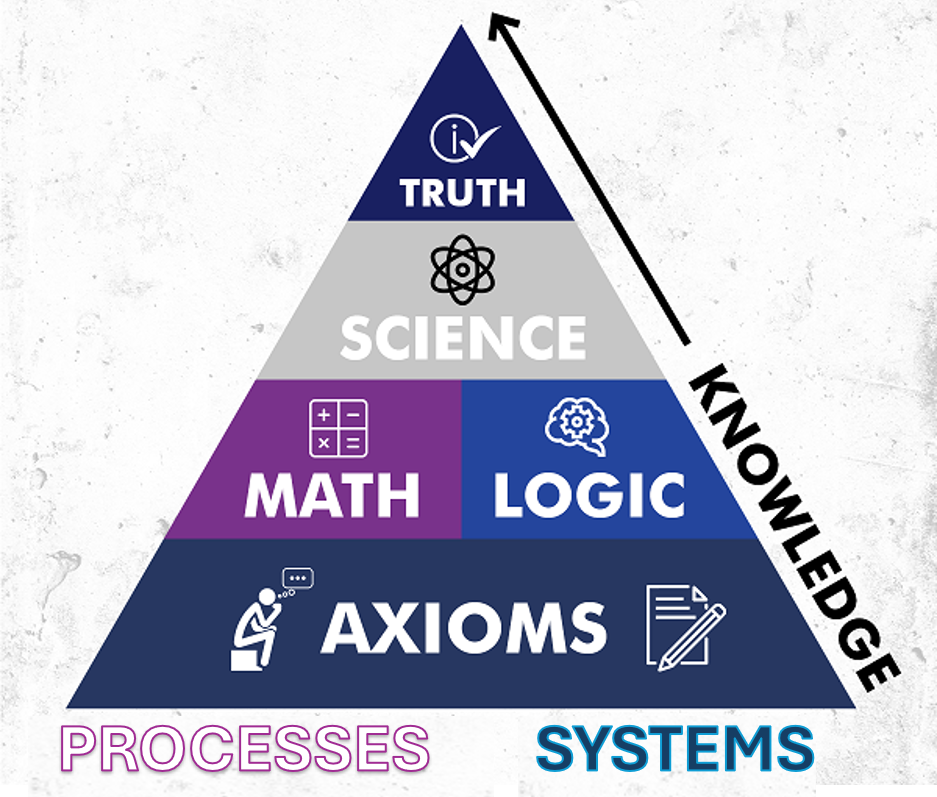
The accompanying image is a clear example of what mathematics cannot do, and it is a very important example of its limitations in understanding modern science, artificial intelligence and also the IT field systematically.
The Symbolic Age Began by Church
Ironically, the symbolic perspective on information technology came right from the beginning, and specifically by a person named Alonzo Church.
Symbolic artificial intelligence has been known since the 1950s as a logical alternative (Good Old AI = Gofai) to mathematical calculation (computationalism), which focuses mainly on flows, crunching numbers, but mathematics does not know type systems, and cannot distinguish logical relationships between things as a human brain does: questions, assumptions, answers and metacognition. If a mathematician is given the task of weighing them, he will make them into some kind of Gödel numbering system, the indices of which are controlled by artificial intelligence at most, if that.
Humans use natural language, and logic provides support for specifying arguments better than mathematics, whose central decision-making, including hypotheses, is based on clear logic.
Which one proves it more accurately?
Where does mathematics’ own evidentiary power lie? Mathematics likes to show with Occam’s razor that the solution that involves fewer details (but not too few) is better: “the earth is not the center of celestial mechanics”. Yet the universe is so vast that even the best mathematician cannot find its boundaries (yet). It is unlikely that our Sun is the center of the universe, because many similar star combinations are known. Logic has the ability to pose new kinds of questions and hypotheses. Even the reflection on beliefs is at best logical in nature, modal logic, questioning and searching for possibilities.
Logic is indeed the most central feature in systems science (vs. Prof Bonnay), and thanks to it, every person, in their own way, with their own cognition, can ponder various puzzles, without having to ask mathematicians or even artificial intelligence for answers.
Challenges for completeness
The answer to finding superiority in a VUCA world depends on the context. Ultimately, the final answer is found, if it is to be found, in a proof that can be accepted: MOT , which follows a sense of tautology, a unification that told the semantics of order. Critics, however, recall in this context Russell’s paradox , the situation where an element belongs to a set even though it should be outside its set.
Gödel has found the incompleteness theory (mathematics), and later completeness of logic by the resolution theorem of Robinson and Kowalski.
The title image shows that mathematics and logic need paradoxes. While mathematics studies processes, logic studies… in general, systems from which more specific solutions can be derived, without stumbling over details.
Links:
- Dennis Bonnay: Logic and Mathematics https://serious-science.org/logic-and-mathematics-7243
- Intelligent Speculation: Think critically:
https://www.intelligentspeculation.com/blog/the-foundations-of-logic