Is it possible to combine a passionate sports game and the MST theory of cybernetics from the 1990s, as well as modern technology and the architecture of thought – seamlessly?
Yes, let’s look at it!
ChatGPT recommends: Here is a lightening up, but scientifically sound description for the website. Andreas functions as a physical object, a perception-driven cybernetic system, and a thinker who creates meaning at the same time.
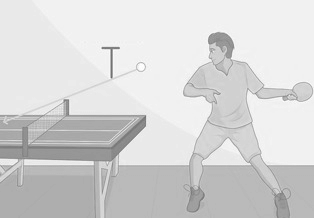
From the opposite side, the ball hit by Bill approaches Andreas. The first event is physical: light, movement, direction, speed, and the curve of the ball form a sensory stimulus. At the same time, a metaphysical, or conceptual, event begins: Andreas recognizes the situation as a game, a task, and an opportunity. The ball is a physical object, but in his mind it also becomes a sign that calls for action.
- α opens the meaning: Andreas directs his attention to the ball and recognizes the meaning of the situation. It is about the return, not just seeing the movement.
- π activates a learned principle: he knows the logic of the game, the use of the racket, the timing, and the fact that a successful return requires the right relationship to the ball’s trajectory.
- χ forms information: the speed, direction, height, spin and distance of the ball become a model in his field of perception.
- ΔΨ brings pressure: the ball approaches quickly, the time window shrinks and a critical threshold is created in the situation.
- β organizes the body: the legs, body, hand, gaze and balance are set as an action structure.
- φ chooses a solution: Andreas forms the idea of the return, the angle of the club, the force and direction.
- τ implements the movement: the body executes the stroke, the club meets the ball and the planned solution becomes an event.
- Ω closes the feedback loop: Andreas sees the ball successfully return, the body relaxes and the mind receives confirmation of the successful action.
Here the physical and metaphysical unite in one moment. The physical ball travels in space, but in Andrea’s system it also travels as meaning: as perception, prediction, choice, motor program and feedback. The movement of the ball generates the movement of thought. The movement of thought guides the movement of the body. The movement of the body changes the game situation. Through feedback, Andreas learns, calms down and prepares for the next opportunity.
From the perspective of GoodReason, the situation shows the entire α–Ω arc in a small everyday phenomenon. The ping-pong ball makes visible the basic form of systemic consciousness: a person encounters change, gives it meaning, organizes his actions and returns the experience to a learning whole. This makes Andreas much more than a physical object. He is a momentarily tuned cybernetic system, in which perception, intention, body, solution and feedback.
The table tennis return demonstrates a metasystemic transition (MST) in miniature. The approaching ball first determines the position and movement in the physical space. Andreas simultaneously orients himself to the learned mental space of perception, timing, rules, body readiness and anticipatory thinking.
Physical movement becomes a response, response a model, model an association, association a thought and thought a part of the game culture. In GoodReason terms, the event progresses from the origin (1D) and direction (2D) towards range of motion (3D), gesture symbolism with its physiology (4D), reaction (5D) and systemic laws (6D) towards a higher game vision (7D).
The physical ball becomes a cybernetic signal, and the player’s return stroke becomes a new climax, where body, mind, feedback and game tempo form one systemic act. Bill gets an angry ball in return!
A table tennis return offers a compact demonstration of axiomatic systems science. The incoming ball is a physical object carrying velocity, spin, angle and force, yet for the player it becomes a cybernetic signal that activates perception, anticipation, bodily organization, strategic choice and feedback. In the language of metasystem transition, movement becomes response, response becomes pattern, pattern becomes association, association becomes thought, and thought becomes part of the culture of the game. In GoodReason terms, the same event unfolds through α–Ω as purpose, principle, information, pressure, organization, solution, implementation and feedback. The example shows how a single athletic act can integrate physics, cybernetics, systemic modelling and the geometry of thinking into one coherent explanatory space.