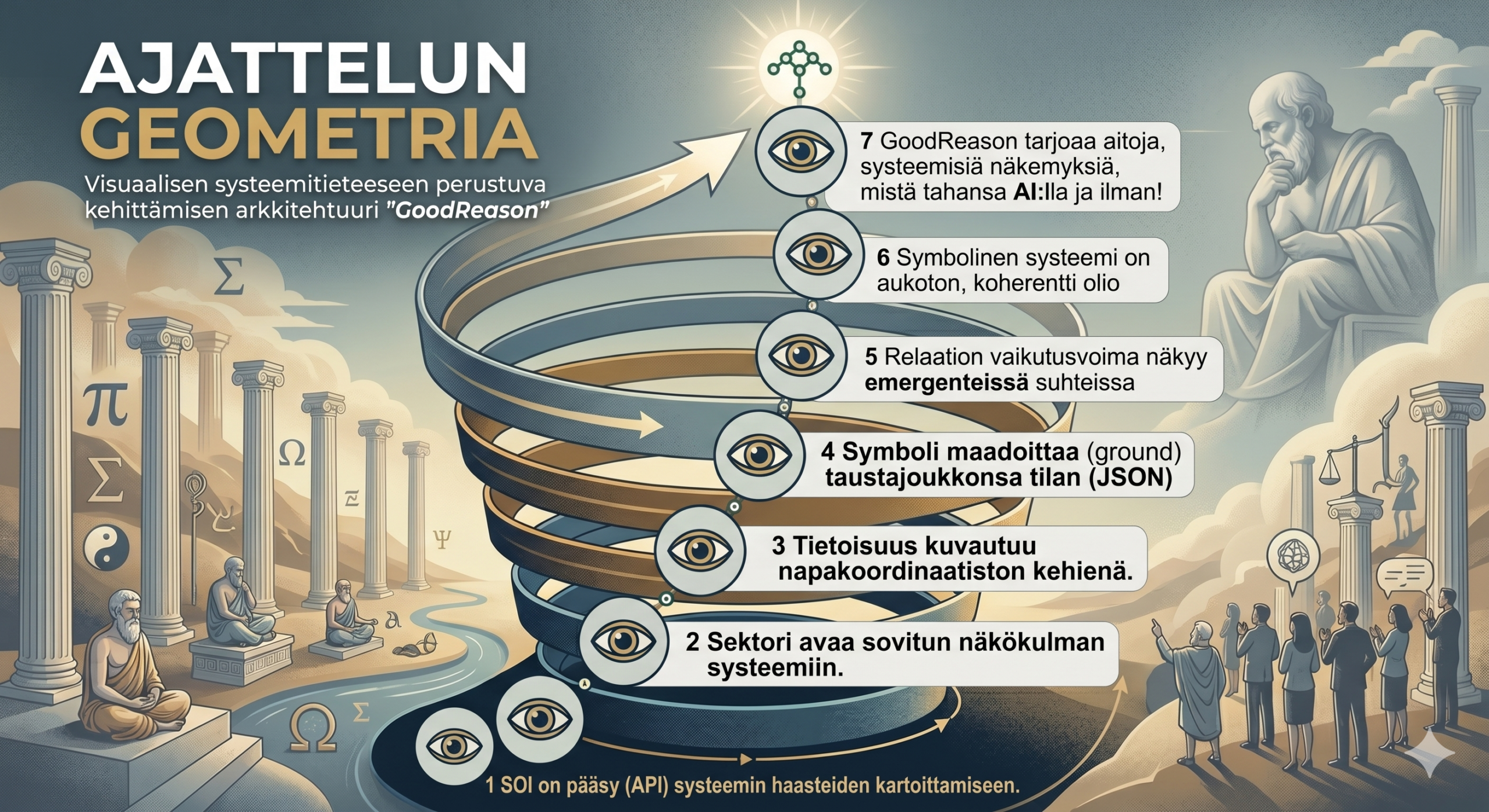
3D Consciousness — Evaluating Distance and Level
When 2D describes orientation in the directions of thought, then 3D brings in distance, depth, and the level of consciousness.
Andreas moves in the geometry of thought toward a selected α–Ω direction and evaluates how deep or distant the matter is: whether it concerns an easy calculation in everyday life, a difficult choice, a complex dependency, a critical energy crisis, cognitive relearning, disruptive change, or finally a question at the level of society and civilization.
When Andreas has found a direction for orientation, he evaluates how far the matter reaches beyond his immediate everyday life and how precisely it should be brought into consciousness. The same observation is close and simple, or it opens far into the levels of society, technology, energy, security of supply, and the future.
Here, consciousness means the level of becoming aware. Andreas treats the price of gasoline as a simple cost, a difficult budget question, a complex dependency, a critical infrastructure risk, or a broader question about the energy and mobility system in which people live. There are many alternatives, but the GoodReason symbols list them orthogonally: focus on one at a time, and partial solutions already begin to emerge. Consciousness gives thinking distance: how deeply the matter deserves to be followed and at which level its meaning becomes decisive. Gärdenfors’ geometry of thought supports this determination through the concept of distance.
Example Situation
At first, Andreas calculates how much the rise in gasoline prices adds to his monthly expenses. The equation is not as linear as school mathematics once taught. This is a question that describes and favors closeness. If the cost is small, the matter remains on Ring 1: he adjusts his driving habits or accepts the change. If the costs grow significantly, the matter moves to Ring 2. Andreas compares alternatives: routes, commutes, carpooling, public transport, or replacing the car. If these alternatives involve uncertainty, schedules, family needs, electric car charging, interest rates, insurance, and depreciation of the car’s value, the matter rises to Ring 3.
On Ring 4, Andreas begins to see a broader risk. If electric cars become more common and the electric grid is strained by data centers, market disturbances, or external threats, personal mobility becomes connected to the resilience of the entire energy sector. Then the question becomes: what kind of society ensures safe mobility, the availability of electricity, and secure infrastructure for people in all residential areas?
Systemic Specification
3D brings rings and the axes of polar coordinates into thinking. They describe how a simple observation develops toward deeper awareness.
Ring 1 describes an easy relation: Andreas identifies the cost and makes a small adjustment.
Ring 2 describes a difficult choice: he compares alternatives and reorganizes everyday arrangements.
Ring 3 describes a complex situation: costs, technology, habits, work, family, and uncertainty become interconnected.
Ring 4 describes a critical state: disruption, collapse, rapid change, or infrastructure vulnerability requires communication and participation.
Ring 5 describes cognitive learning: Andreas finds a new way to understand mobility.
Ring 6 describes disruptive reorganization: the old mode of action is overturned and a new structure begins to guide everyday life.
Ring 7 describes the philosophical and collective level: the question concerns societal learning, security of supply, technological responsibility, and the protection of people’s everyday life.
The same examination is carried out in eight directions. The symbol α asks about the identity of the human being and the state. π asks about the theoretical foundations of energy sufficiency. χ asks about availability, information, and distribution. ΔΨ asks about the tension between cost pressure and security. β asks about the organization and diagnostics of the energy sector. φ asks about solution models and technologies. τ asks about the functioning of the distribution network. Ω asks about security of supply, feedback, anticipation, and self-criticism.
What Emerges in the Phase of Consciousness?
As a result of consciousness in 3D, Andreas begins to distinguish the level of consciousness on which the matter deserves to be handled. He notices that the price of gasoline is a signal close to everyday life, but behind it lies a much more distant systemic question: energy sufficiency, infrastructure resilience, technological dependency, and society’s ability to anticipate crises.
For Andreas, the result is this:
“This matter is not located only in my wallet. It is also located on the rings of mobility, energy, the electric grid, societal preparedness, and future choices. I must distinguish which part is easy to solve myself and which part belongs to the broader responsibility of the energy sector.”
Note
Consciousness grows when a person notices the different distances of a situation. A nearby cost, personal identity, the possibility of an electric car, the burden on the energy sector, and society’s security of supply are different points on the same map. They do not have to be solved all at once. They show how the same observation is located at different distances in the map of thought.
Avoiding the boiling frog trap requires exactly this: a slowly changing situation is made visible before it becomes a crisis. Many archetypes of systems thinking are connected to challenges of consciousness, because they describe errors, distortions, delays, and misunderstandings in becoming aware of a system.
David Bohm’s idea that thought is a system fits this dimension well. Thought moves through the human being, the body, society, culture, and history. Andreas does not think alone in a vacuum, but in the middle of learned habits, everyday structures, energy markets, and societal infrastructure. 3D helps reveal how far a single observation truly reaches.
Summary
In GoodReason, 3D defines depth: the distance through which thought moves from immediate observation toward broader awareness. Consciousness means here the level of conceptual orientation, not a closed psychological definition. The starting information is the selected origin from 1D and the directions opened in 2D. In the driver case, the rising fuel price may first appear as an irritation, but deeper levels reveal budget limits, mobility habits, dependency structures, long-term choices, and wider systemic effects. The processing begins by asking how far the situation should be examined and what level of awareness is needed for responsible interpretation. A shallow level may support quick reaction, while a deeper level allows comparison, reflection, and systemic learning. The typical result is a clearer sense of depth: the issue is no longer only a price signal, but a layered situation with personal, structural, and systemic meaning.
3D gives thought depth. Consciousness means the level of conceptual orientation through which the selected issue is examined. In the driver case, the fuel price is not only an irritation or cost signal, but a layered situation involving habits, limits, dependencies, choices, and feedback. The result is a deeper understanding of what the issue actually means.