4D Conceptualization — Symbolic Reference
In the phase of conceptualization, 4D, the problem-setting reaches the actual core idea of GoodReason: thought receives a symbolic address. In the earlier dimensions, Andreas became interested, oriented himself, and evaluated distance. Now he begins to form key points that are used in conversation, search, agent work, argumentation, and further reasoning.
A symbol makes the place of thought referable.
When Andreas says, for example, χ3, he means something more precise than general “information about energy”. He refers to a specific direction and a specific level: a critical point of information, availability, modelling, and uncertainty. When he says ΔΨ3, he points to the direction of change pressure, criticality, constraints, and possible disruption. When he says Ω4, he brings forward feedback, anticipation, self-criticism, and critical learning.
A dynamic coordinate is considerably stronger than an ordinary concept map. In an ordinary concept map, one word is connected to another word. In GoodReason, the symbol receives a coordinate: direction + ring + meaning + possible argument + further search. Through the symbol, “truth” becomes traceable.
When Andreas has found a direction and evaluated the level of the matter, his thoughts need references, links, and points of reference that function like variables in mathematics. Conceptualization means that scattered observations, thought experiments, and uncertainties begin to receive a symbolic form, purpose, and function.
In GoodReason, a symbol is expressed or connected to knowledge in ten different ways: verbally, as an α–Ω sign, as a concept, as a model, as an argument, as a scientific discipline, as an information structure, as an IT object, as an agent, or as a search instruction given to artificial intelligence, a prompt. By definition, the function of a symbol is to “refer to something”. It makes a point of thought recognizable and transferable: one returns to it, compares it, tests it, and forms an argument from it. It enables abstract thinking.
In GoodReason, the symbol receives an exact coded place. For example, π4 refers to the theoretical perspective on Ring 4, where the situation is critical, tense, or rapidly changing. χ3 refers to the complex point of information and environment. ΔΨ3 indicates critical change pressure. Ω4 raises the question of whether anticipation, feedback, or self-criticism has been sufficient.
In the phase of conceptualization, knowledge is still exploratory, but it is already graspable and engaging, in the same way as AI sessions. Andreas takes one symbolic point and turns it into a question, a search, a conversation, an AI prompt, or an argument. A new symbol functions as a hypothesis: something essential is found beneath it. When a symbol receives justified content, it becomes a key point for further reasoning and a strong argument in debate.
Andreas’ Driving and Energy Example in 4D
Andreas places his observations into polar coordinates as follows:
| Symbol | Andreas’ question | Nature of knowledge |
|---|---|---|
| α2 | Does current car use still fit my way of life and identity? | personal meaning |
| π3 | With what model do I evaluate the price of energy, car consumption, and mobility costs? | explanatory model |
| χ3 | What do I know about the availability of electricity, gasoline, charging, and distribution? | information and uncertainty |
| ΔΨ3 | Does the energy sector contain too many critical change pressures at the same time? | recognition of risk |
| β4 | Is the organization of the energy sector strong enough in a disruption? | structure and diagnostics |
| φ3 | Which solutions are realistic: electric car, hybrid, public transport, remote work, backup system? | design of alternatives |
| τ4 | Does the distribution network function when everyone needs energy at the same time? | implementation and integration |
| Ω4 | What feedback do crises, price increases, and disruptions give about my own choices and society’s preparedness? | learning and anticipation |
Here the practical force of GoodReason is already visible. Andreas receives from one confused concern a set of points that are handled one by one. He starts, for example, from χ3, because he needs reliable information. Then he moves to ΔΨ3, because the change pressure appears critical. After that he examines φ3: what alternatives are available. Finally, he returns to Ω4: what is learned from this, and what kind of preparedness would have been reasonable.
The Hotspot Idea as a Hot Point in the Movement of Thought
In 4D, hotspots arise. They are points where Andreas notices that thought needs additional information, verification, or a decision.
For example:
χ3 red: information about the availability of electricity, charging capacity, or price development is missing.
ΔΨ3 red: cost pressure, uncertainty, and infrastructure risk accumulate.
τ4 red: the distribution network, charging infrastructure, or backup arrangements form a critical bottleneck.
Ω4 red: feedback shows that anticipation has been insufficient.
From these, search requests arise directly. Earlier arguments serve as facts, and new arguments arise for later examinations:
χ3: “Find out how reliably electric vehicle charging infrastructure works in a disruption.”
ΔΨ3: “Evaluate what kinds of change pressures arise if fuel becomes more expensive and the electric grid is strained at the same time.”
τ4: “Check how mobility functions if the electric grid is down.”
Ω4: “What does feedback from previous energy crises reveal about gaps in preparedness?”
What Emerges in This Phase?
As a result of conceptualization, Andreas receives a map of arguments that he stores in his memory, even without a computer, or with the help of one. He has symbolic points to which he returns. Some points become stronger, some are overturned, and some remain open. The symbols make thought discussable: Andreas speaks with himself and with an expert, artificial intelligence, or a community more precisely than ever before. He establishes a crowdsourcing community to challenge the largest problems together.
This is also the beginning of axiomaticity. When a point has been sufficiently justified, it begins to function as a starting point for further reflection. It is a practical axiom: “on this basis, the next question is now built.”
Summary Concerning Conceptualization, 4D
In 4D, Andreas transforms uncertain observations into symbolic points of reference. A symbol such as χ3 or ΔΨ3 gives thought an address: from which direction and at which level of consciousness the matter is examined. This creates hotspots, arguments, and search keys that are also given to artificial intelligence. Conceptualization does not close thinking; it makes the points of thinking visible, testable, and connectable.
The symbol is highly central to the Geometry of Thought in GoodReason, because the symbol connects cognition, semiotics, logic, artificial intelligence, IT structure, and scientific argumentation.
GoodReason and Universality
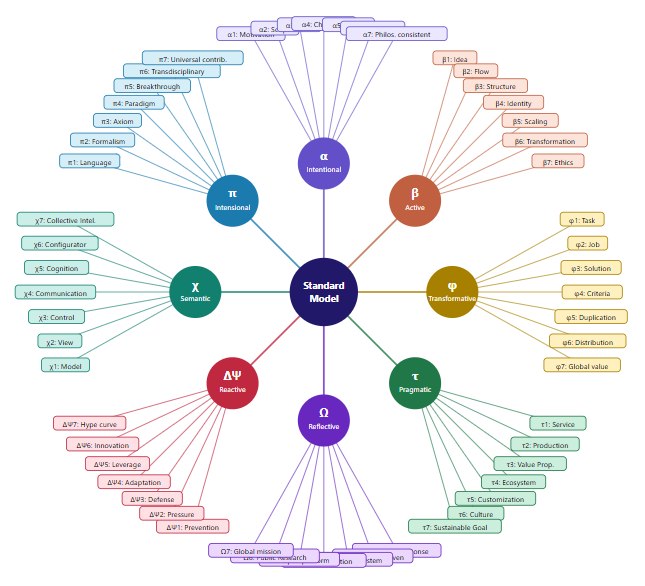
At the core of GoodReason is the universal model, shown in the image: a multilevel JSON structure containing default values for each of the 56 symbols. These are used for communication and knowledge search from artificial intelligence as prompts — the most powerful prompts of all time — and the image shows the guiding values from which the work begins.
Specializations of this standard model are created for different fields and different purposes. Recursive IT substructures are created for the symbols, because their internal structure is the same: isomorphism. This enables a new practice of computation and executability: atomism. SystemsRegistry is a module that stores different system models, such as Technology, Anatomy, Brain etc.
Semantics of summary
In GoodReason, 4D defines symbolicity: the point where a viewpoint becomes a reference that can be named, shared, compared, and reused. A symbol does not merely label an idea; it opens a conceptual position from which reasoning can continue. The starting information is the selected origin from 1D, the directions opened in 2D, and the depth recognized in 3D. In the driver case, each α–Ω symbol gives the fuel price situation a different reference: α selects the personal context, π grounds the principles, χ models the information, ΔΨ opens the pressure, β deals with structure, φ designs alternatives, τ implements action, and Ω reflects the learning. The processing begins by translating vague concern into symbolic positions that make the issue visible and communicable. Each symbol acts as an atom of orientation, connecting meaning, language, reasoning, and possible action. The typical result is a structured symbolic field in which the issue can be examined without losing its multiple meanings.
4D gives thought a symbolic reference. A symbol makes a conceptual position visible, shareable, and reusable. In the driver case, the α–Ω symbols turn the fuel price situation into distinct references: context, principle, information, pressure, structure, alternative, action, and feedback. The result is a symbolic field where meaning can be handled without reducing it to one explanation.