7D Vision — Science, Culture, and New Meaning
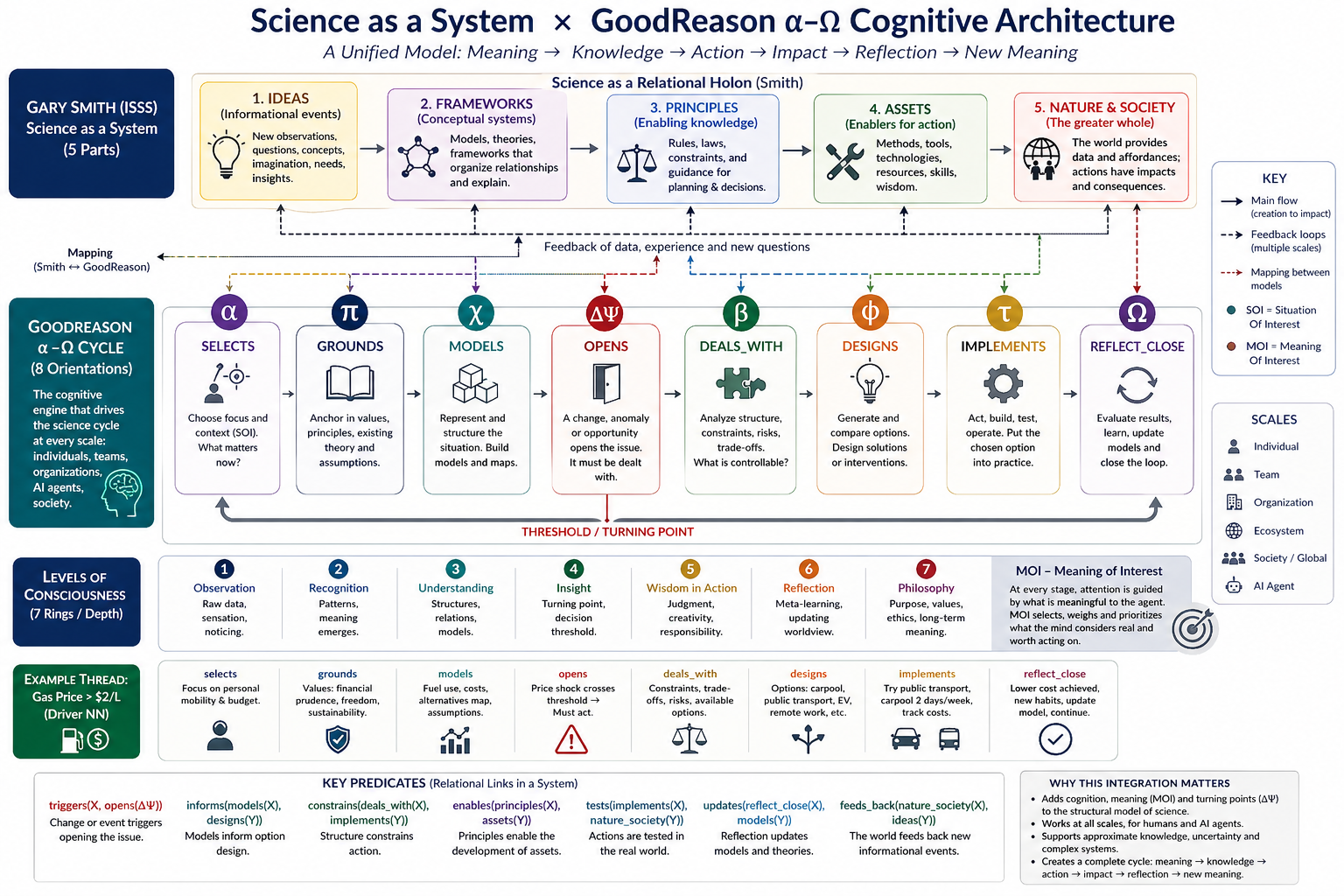
7D is the highest dimension of GoodReason. It raises Geometry of Thought to the level of science, culture, and civilization. At this stage, Andreas has already used the Geometry of Thought to understand his own situation, but 7D expands the question: what kind of science, society, and culture is capable of handling such complex situations wisely?
When the logic of thinking has moved through interest, orientation, consciousness, conceptualization, reaction, and systemic crystallization, it has expanded. The most important question remains: what should be understood from all this at a broader level? 7D is the dimension of vision. It returns thinking to its foundations, now richer, more learned, and more responsible.
At this stage, Andreas no longer examines only his own driving, the price of gasoline, or the alternative of an electric car. He sees his situation as part of the common development of science, technology, energy, infrastructure, society, and culture. His everyday question belongs to a larger whole: how knowledge becomes understanding, how understanding becomes action, and how action produces effects from which society learns.
7D approaches science as a system. Science is not merely a collection of disciplines, methods, or publications, but a continuous cycle of meaning, knowledge, action, impact, and reflection, which should have an understandable interface to connect them. Here ISSS’s views of science as a system and reflective cybernetics, and GoodReason’s architecture are seen as overlapping cognitive models.
Without understanding what cognition and metacognition are, we cannot understand difficult and complex phenomena well, or especially chaotic phenomena and their consequences. Therefore, science must renew and diversify from its 18th century categories to meet the challenges of the hectic 2020s.
Example Situation
Andreas began from a question that seemed personal: gasoline becomes more expensive, driving becomes more difficult. In 7D, he sees that the same question opens the entire learning capacity of society. Energy, transport, data centers, the electric grid, regional equality, security, and sustainable development belong to the same view.
Here Andreas is a user of science. He needs research knowledge, technological solutions, social responsibility, and the ability to evaluate his own action. At the same time, he is part of a culture in which thoughts, habits, technologies, and institutions influence one another. Following David Bohm’s idea, thought is a system: it moves through the human being, the body, society, language, technology, and history.
Systemic Specification
7D is a meta-metatheoretical level: a map of maps. It no longer concentrates on one model, but on how models, theories, actors, and systems relate to one another. In GoodReason, the center is the system: the primal atom around which knowledge begins to organize. When an object is placed in the SOI/MOI origin, it is examined in the α–Ω directions and on seven rings of consciousness.
This creates the direction of unification. Separate sciences, system models, cycles, technologies, and cultural interpretations find a shared surface of examination. For example, cycle archetypes describe recurring structures of processes, while GoodReason provides a semantic geometry for locating and relating them. In this way, lifecycle, recursion, feedback loop, hypercycle, and other cycle types become part of a navigable systemic whole.
Complexity is located in this entire field. It appears in the limits of modelling, in the surprises of change, in the pressure of constraints, and in the emergence of feedback. The task of 7D is to preserve the overall view when individual theories and methods begin to fragment into their own compartments.
What Emerges from This?
The result of 7D is a visionary overall view. Andreas understands that his own everyday problem is a small window into a larger question: what kind of society learns in time, connects scientific fields, uses technology responsibly, and protects people’s everyday life during changes in critical infrastructures?
For science, 7D means the same on a broader level. It calls research away from a fragmented collection of models toward a more unified systemic civilization. Science then serves society by warning against poor directions, building better design models, and strengthening collective learning.
For Andreas, the result is this:
“I now understand that my own mobility belongs to energy, technology, social responsibility, and the ability of science to see wholes. This is not only my choice, but part of broader systemic learning.”
Note
7D is not a final explanation of the world. It is a visionary level in which the human being returns to the foundations and asks what kind of knowledge, science, technology, and culture help society develop more wisely. In this sense, GoodReason is a step toward unification: it gives systems, theories, cycles, actors, and meanings a shared place.
At the center is the system. Around it are built direction, level, symbol, dialogue, action, feedback, and new meaning. From this emerges the Geometry of Thought, in which civilization does not mean only the quantity of information, but the ability to see relations, carry responsibility, and form better wholes.
Core Sentence
7D is the dimension of vision. In it, Andreas sees his own situation as part of the learning of science, technology, energy, culture, and society. For GoodReason, this is the map of maps: the system is placed at the origin, knowledge is organized in the α–Ω directions, and thinking returns to its foundations with new meaning.
Summary
In GoodReason, 7D defines vision: a reflective return to the whole after thinking has moved through origin, direction, depth, symbol, dialogue, and system. Vision is not prediction and not ideology, but the ability to see what has been learned, what remains uncertain, and how an interesting system belongs to a broader systemic world.
The starting point is the systemic view crystallized in 6D. In the driver example, the question is no longer only how to react to a high gasoline price. It is what the situation reveals about personal mastery, mental models, shared vision, learning, infrastructure, energy dependency, and the possibility of a learning society.
The treatment begins by asking whether the earlier interpretation produced only a local answer or a more durable systemic insight. At this level, systems thinking itself must also renew itself: it must move from pre-digital organizational language toward AI-supported, ethically conscious, and symbolically explicit forms of collective learning. The typical result is a reflective viewpoint that returns to the foundations with greater clarity: the matter is seen as part of a broader model of adaptation, responsibility, and systemic development.
7D gives thinking vision. It returns the whole movement to basic principles after origin, direction, depth, symbol, dialogue, and system have formed. In the driver example, the price of gasoline is no longer only a personal cost problem. It reveals habits, dependencies, mental models, shared choices, infrastructure, and the need for learning. The result is a reflective viewpoint that connects local action to broader systemic development.
Summary: Senge’s Subdisciplines Describing Systems Thinking
7D–1 Personal Mastery
The individual recognizes their own situation, limits, dependencies, and learning needs. For the driver, this means the ability to see personal mobility through choices, not only through necessity.
7D–2 Mental Models
Assumptions become visible. The driver notices, for example, the assumption that driving is the only realistic option, even though some needs are arranged differently.
7D–3 Shared Vision
The individual observation connects to shared aims. The price of gasoline is not only a private problem, but also a question of the kind of transport, energy, and regional development that society pursues.
7D–4 Team Learning
Learning expands from the individual to groups and communities. A family, workplace, municipality, or organization learns together new ways of handling mobility and costs.
7D–5 Systems Thinking
The situation is seen through relations, feedback, boundaries, and delays. Price, taxation, markets, infrastructure, consumption habits, and climate goals begin to form one shared systemic picture.
7D–6 Learning Society
Learning rises to the level of society. Systems thinking must renew itself so that artificial intelligence, symbolic models, tacit knowledge, ethical boundary-setting, and collective decision-making meet one another without the illusion of control.
The international knowledge and competence of systems thinking must renew itself, not by abandoning Senge and the foundations, but by raising Senge’s organization-centered thinking into the systems thinking and practice of the IT and AI era. In this development, the learning organization continues to expand into a learning society. GoodReason’s 7D functions here as a return to the foundations: not as repetition of the old, but as…
Aiempi tiivistys
In GoodReason, 7D defines vision: the reflective return to the whole after the movement through origin, direction, depth, symbol, dialogue, and system. Vision is not prediction or ideology, but the capacity to see what has been learned, what remains uncertain, and how the System of Interest belongs to a wider systemic world. The starting information is the crystallized systemic view formed in 6D. In the driver case, the question is no longer only how to respond to a high fuel price, but what the situation reveals about personal mastery, mental models, shared vision, learning, infrastructure, energy dependency, and the possibility of a learning society. The processing begins by asking whether the earlier interpretation has produced only a local answer or a more durable systemic insight. At this level, systems thinking itself must also be renewed: it has to move from pre-digital organizational language toward AI-supported, ethically aware, and symbolically explicit forms of collective learning. The typical result is a reflective viewpoint that returns to basics with greater clarity: the issue is seen as part of a broader pattern of adaptation, responsibility, and systemic development.
7D gives thought vision. It returns the whole process to basic principles after origin, direction, depth, symbol, dialogue, and system have been formed. In the driver case, the fuel price becomes more than a personal cost problem: it reveals habits, dependencies, mental models, shared choices, infrastructure, and the need for learning. The result is a reflective viewpoint that connects local action with wider systemic development.