6D System — Crystallizing Understanding
In this architecture, dimension 6D is the metaphysical interface, where the Geometry of Thought begins to become a systemic worldview. Interest, orientation, consciousness, symbols, and dialogue have created material for understanding. In 6D, these begin to crystallize into a system: Andreas, energy, driving, infrastructure, society, technology, markets, education, and science begin to appear in the same systemic view.
The image based on Andreas Hieronymi’s classification of the systems field fits this dimension well, because it shows the enormous breadth of systems: physical, living, cognitive, social, and technological systems. The task of 6D in GoodReason is to give these a shared conceptual point of contact. It is not the dominance of one field, but the relating of different system types within the same space of understanding.
6D: The System as a Crystallizer of Conceptions
Systemic thinking begins to have real effect when scattered concepts, symbols, observations, dialogues, and influences begin to form an understandable whole. 6D is the dimension of this crystallization. It asks what kind of system is actually involved, where its boundaries are located, which parts influence one another, and what kind of overall picture emerges from the situation.
According to a systemic worldview, every object of inquiry is understood as a system. This makes 6D a broad and demanding dimension. The same energy question is connected to physical systems, technological systems, the economy, society, human cognition, everyday choices, and ultimately also the philosophy of science. For this reason, a single model covers only part of the task. What is needed is the ability to see how different system models find one another.
Example Situation
Andreas began from the price of gasoline. In 1D, he noticed its meaning for himself. In 2D, he searched for directions. In 3D, he evaluated the level of consciousness. In 4D, he placed key points into symbols such as χ3, ΔΨ3, φ3, τ4, and Ω4. In 5D, he began to ask, check, discuss, and use artificial intelligence for handling knowledge and alternatives.
In 6D, Andreas sees that the matter is a system of mobility and energy. It includes his own everyday life, car use, the price of fuel, the possibility of an electric car, the charging network, electricity production, data centers, markets, security, preparedness, political decisions, and society’s security of supply.
At this point, the question expands: if everyone moves to electric cars and electricity is periodically scarce, what happens to mobility? Who is responsible for ensuring that people have safe infrastructure every day, also in sparsely populated areas? At what level do the state, markets, technology, and the citizen share responsibility?
Systemic Specification
The task of 6D is unification. It gathers different system types, theories, models, and practical observations into a shared picture. The physical system appears as energy and the electric grid. The technological system appears as cars, charging, automation, and data centers. The social system appears as decision-making, prices, regional policy, and inequality in everyday life. The cognitive system appears in how people understand risk, change, and their own alternatives.
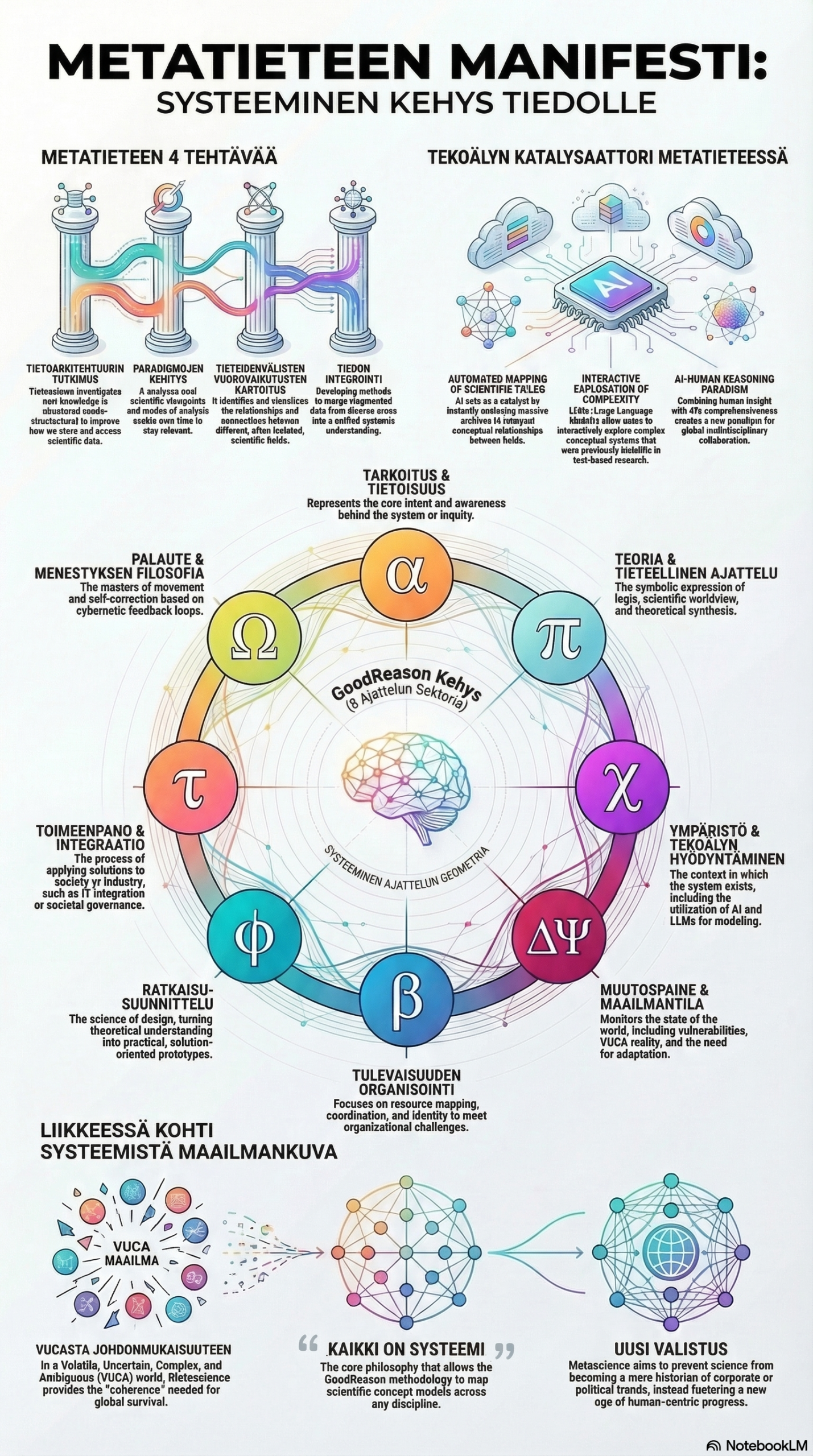
At this point, the α–Ω directions of GoodReason function as crystallization points of the system:
α: purpose, identity, and responsibility of the human being, community, and state
π: theories, models, and principles of energy sufficiency
χ: availability, environment, information, data, and distribution conditions
ΔΨ: pressures, disruptions, forces of change, costs, and the tension between cost and security
β: organization, governance, diagnostics, and leadership of the energy sector
φ: technologies, solution models, electric cars, backup systems, and algorithms
τ: implementation, integration, distribution networks, services, and practical functionality
Ω: feedback, security of supply, anticipation, learning, and self-criticism
When these directions become connected, syntax and facts begin to seek an understandable form. Knowledge ceases to be an isolated collection of observations and becomes a systemic picture.
What Emerges from Dimension 6D?
The result of 6D is a crystallized systemic view. Andreas understands that his own driving is connected to a larger question of the energy sector, infrastructure, and social responsibility. His private concern functions as a gateway to broader systemic understanding.
For Andreas, the result is this:
“The price of gasoline was only a visible signal. The real system includes mobility, energy, the electric grid, markets, technology, preparedness, and the responsibility of society. My own choice needs a connection to this whole.”
At this stage, research-oriented questions also emerge:
How does the energy sector withstand electrification?
How does society secure mobility also during disruptions?
What kinds of solutions strengthen both individual freedom and security of supply?
How are cognitive understanding, technical infrastructure, and political responsibility brought into the same discussion?
Note and Specification
6D does not mean closing the inquiry into one model that explains everything. It means crystallizing a systemic whole so that different fields, models, and actors find a shared surface of examination. This is one of the great challenges of the systems field: knowledge is rich, but scattered. Without a shared cognitive methodology, physical, living, cognitive, social, and technological systems remain separate islands.
Systems thinking and systems science are so broad that many people understand them only from their own position, at the micro level. Macro-level systemic views are presented elsewhere on this website.
GoodReason’s 6D makes visible how these islands relate to one another. It works like a lamp: it illuminates the relevant points so that concepts, facts, symbols, models, and action begin to support understanding. Then systems thinking changes from a general ideal into a practical capacity to see how parts, wholes, and responsibilities relate to one another.
Summary
6D is the dimension of systemic crystallization. In it, Andreas no longer examines only his own driving, but sees it as part of energy, technology, infrastructure, society, and security of supply. Different system models begin to find one another when they are placed in the same α–Ω coordinate system and examined in the light of shared systemic understanding.
In GoodReason, 6D defines system formation: the point where relations, boundaries, functions, tensions, and feedback begin to crystallize into an intelligible whole. A system is not merely a collection of parts, but a structured field in which meanings, constraints, actions, and consequences become connected. The starting information is the dialogical exchange formed in 5D. In the driver case, the issue is no longer only the price of fuel, but a mobility system involving income, distance, work, habits, vehicle efficiency, available alternatives, taxation, markets, infrastructure, and personal values. The processing begins by asking what belongs to the system, what remains outside it, and which relations most strongly shape the situation. Different symbolic directions are now integrated into a coherent but revisable model. The typical result is a crystallized systemic view that supports comparison, decision-making, intervention, and learning without reducing the situation to a single cause.
6D gives thought systemic formation. Relations, boundaries, functions, tensions, and feedback begin to crystallize into an intelligible whole. In the driver case, the fuel price becomes part of a mobility system involving income, distance, habits, vehicle efficiency, alternatives, taxation, markets, infrastructure, and values. The result is a coherent but revisable systemic view that supports decision-making and learning.