8D Axiomatics is a meta-level for studying the entire architecture, how to justify, test and place concepts, values and responsibility in the philosophical discussion of science. When 1D–7D describe how everyday thinking expands from interest to insight, 8D asks under what conditions this whole is considered axiomatically justified from the perspective of science, systems science and meta-science.
Axiomatics suits well to study the problem of demarcation in general. If artificial intelligence, market discourse, ideology, pseudoscience and responsible research are mixed together in the 2020s, then research into axiomaticity is needed: on what basis is a statement, model, system or method of explanation accepted as the starting point for further reasoning.
Axiomatics as a basic research discipline
Axiomatics is a foundational research discipline that studies the principles, conditions and consequences by which concepts, systems, theories and models become acceptable starting points for justified reasoning.
This places axiomatics close to logic, metascience, philosophy of science, formalization, and systems science. It is not simply the study of mathematical axioms, but a broader science of reasoning.
The purpose is
.. to study when a statement, concept, model, system or category serves as a legitimate starting point in the construction of knowledge
In this sense, “system as the fifth basic category of science” is precisely an axiomatic statement. It is not presented as an empirical measurement result, but as a basic categorical solution concerning the architecture of science.
8D Axiomatics — Justification of the System
Its task would be to examine on what basis 1D–7D constitute more than a pedagogical model. It asks:
- What makes a system a basic category?
- Under what conditions is systemicity a fundamental concept of science?
- How do symbols, circles and directions justify reasoning?
- When does the content produced by artificial intelligence meet the conditions of justification?
- Where is the boundary between science, pseudoscience, ideology and technical simulation?
- How does GoodReason make its own assumptions visible and traceable?
System as the fifth basic category
Our strong and consistent thesis is:
System should be established as the fifth basic category of science, alongside Immanuel Kant’s quantity, quality, relation, and modality of time.
This does not mean repeating Kant, but continuing Kant’s legacy under the conditions of systems science and the age of artificial intelligence. Quantity gives measurability. Quality gives properties. Relationship gives connections. Modality gives possibility, necessity and conditionality. The system gives wholeness, boundaries, organization, feedback, dynamics and emergence.
Therefore, the system is not ashamed to stand alongside other categories. On the contrary: it brings them together into a functional whole. Without the system category, quantity easily remains a measure, quality a property, relationship a dependency and modality a possibility. The system asks how all of these form a functional, changing and feedback whole.
This is the essence of 8D:
Axiomatics examines whether “system” is justified as a foundational category of science.
Axiomatics and demarcation
The demarcation problem is an excellent fit for this, because it is related to the conditions under which a claim belongs to science. In the era of artificial intelligence, this question becomes more acute. A language model produces a plausible text, but its production as such does not meet the conditions of scientific justification: the starting points, sources, chains of reasoning, responsibility, testability and conceptual traceability often remain unclear.
Axiomatics could serve as a boundary work here:
Axiomatics studies the boundary between justified foundations and unsupported assertions.
It is not censorship or school politics. It is the study of justification. It asks when something is a starting point, when it is only a hypothesis, when it is a heuristic, when it is an ideology, and when it is just rhetoric.
The strength of GoodReason here is its traceability. When an idea is given a symbolic address, a circle, a direction, a MOI/SOI origin, a dialogic interface, and a systemic crystallization, it becomes much more evaluable than a free language model text.
Axiomatics alongside systems science
Axiomatics would approach systems science objectively but appreciatively. It would not turn systems science into an ideology, but would investigate on what basis systems science is able to formalize and structure other knowledge.
Systems science is in a special position here because it deals with:
- hard systems
- soft systems
- complex systems
- technical systems
- cognitive systems
- social systems
- scientific and metascientific systems
Because of this, it is able to provide an architecture of reasoning that no single specialized science can provide. Mathematics provides form. Logic provides reasoning. Cybernetics provides feedback. Systems science provides wholeness. GoodReason provides cognitive-symbolic navigation.
The meaning of the title image
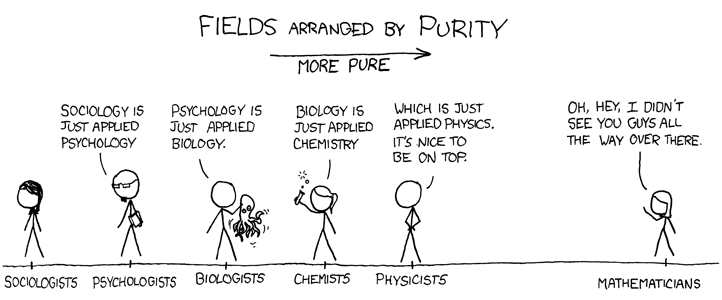
The “Fields arranged by purity” image above is a good reminder of what we are trying to overcome here. It mocks the hierarchical purity mindset, which supposedly arranges fields as more valuable according to how close they are to mathematics. From GoodReason’s perspective, this is precisely the reductionist fallacy.
Axiomatics does not organize disciplines according to “purity.” It asks on what basis different disciplines form justifiable claims and how their concepts are systemically related. Then mathematics is not the highest tower, but one necessary form of justification alongside others.
Proposal for 8D core design
8D Axiomatics — Justification of Science
8D introduces axiomatics as the research of foundations. After the Geometry of Thought has moved through interest, orientation, consciousness, conceptualization, dialogue, system and vision, the final question concerns justification: what makes a concept, model, system or category acceptable as a starting point for scientific reasoning?
In GoodReason, this question becomes decisive. If “system” is accepted as a foundational category of science alongside quantity, quality, relation and modality, then systemicity becomes more than a useful perspective. It becomes an axiomatically justified basis for organizing knowledge, evaluating complexity and renewing science in the age of artificial intelligence.
The rigorous definition
Axiomatics is the foundational study of justified starting points. It examines how concepts, categories, systems, theories and models become acceptable bases for scientific reasoning, especially under conditions of complexity, artificial intelligence and contested demarcation.
Conclusion
This makes the whole much stronger: GoodReason does not remain a cognitive methodology, but becomes a metascientific research program.