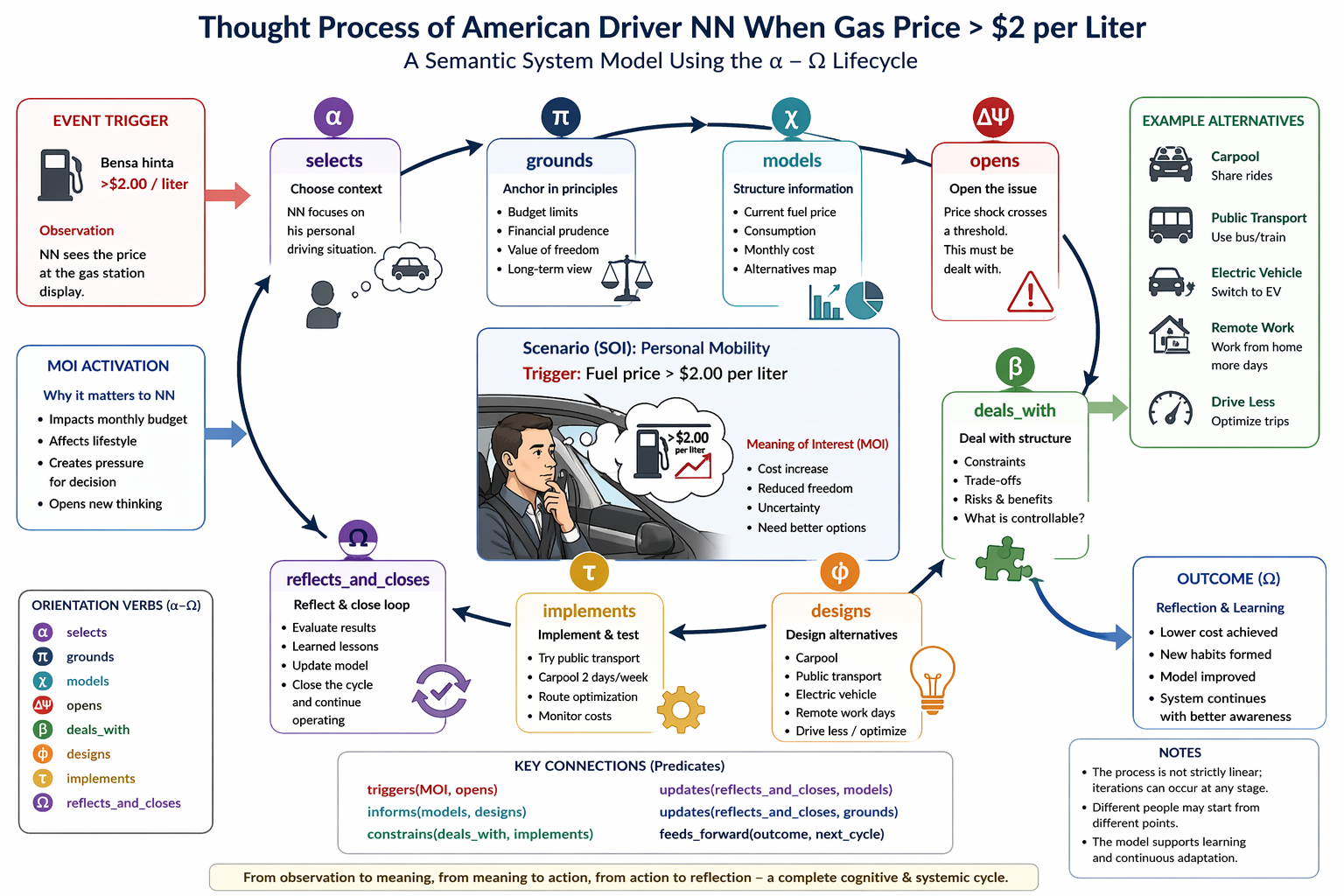
A driver notices that the price of fuel has risen above a personally critical level. At first, the situation appears as a simple cost problem, but in GoodReason it becomes a compact example of systemic thought. The driver is not only reacting to a price signal, but entering a conceptual space where personal need, mobility, economy, infrastructure, alternatives, habits, and feedback begin to interact.
In 1D, the issue becomes interesting: the driver’s mobility under rising cost pressure is selected as the System of Interest. In 2D, the situation is opened through directions: purpose, principles, information, pressure, structure, alternatives, action, and feedback. In 3D, the driver moves from immediate irritation toward deeper awareness of dependencies, limits, habits, and long-term choices. In 4D, these viewpoints become symbolic references that can be named, compared, and reused. In 5D, dialogue begins: the driver compares feelings, numbers, routes, public information, vehicle data, AI suggestions, and possible changes in behaviour. In 6D, the issue crystallizes as a mobility system rather than a single fuel-price problem. In 7D, the case returns to basic insight: what has been learned about personal mastery, mental models, shared choices, systems thinking, and the possibility of a learning society?
This example shows how GoodReason turns a familiar everyday concern into a structured movement of thought. The purpose is not to give one correct answer to the driver, but to make the thinking process visible, shareable, and improvable.